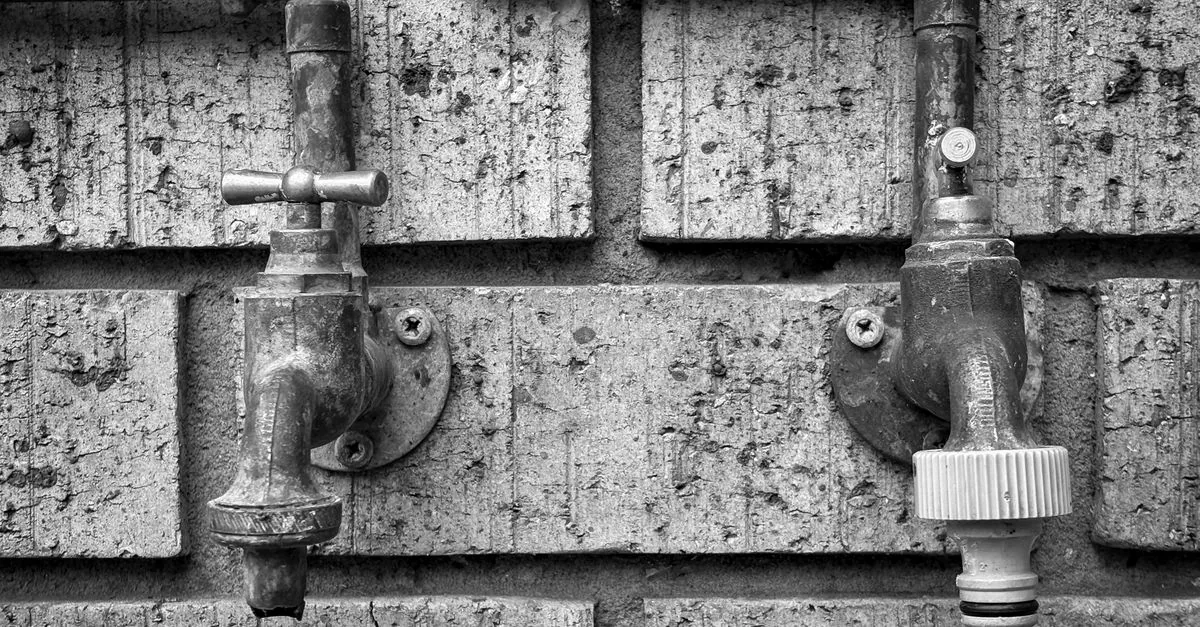
This page is specifically about one fixture. If the whole flat is weak — every tap, every bathroom, worse on the top floor, worse in the morning — you have a supply, tank or pump question, and our guide to low water pressure across a Delhi home is the right page. Come back here when the rest of the house is fine and one tap is not.
The single-fixture case is a much better problem to have, because the list of possible causes is short and most of it is between the isolation valve and the spout — a stretch of about half a metre that you can reach without touching a wall or a riser. The commonest cause by a distance is a blocked aerator, the small mesh screwed into the end of the spout, and in this city’s hard water it blocks with white scale and grit reliably enough that it is worth checking before anything else. It is free, it takes two minutes, and it needs no tools beyond a cloth.
After that come a partly closed isolation valve, a clogged inlet mesh inside a mixer, a kinked or crushed flexible connector under the basin, and a scaled cartridge inside the mixer body. This guide takes them in that order — cheapest and likeliest first.
A note first. XpertWorker is a marketplace, not a service company. We do not set any professional’s price and we never charge you a paisa. Every professional quotes you free before starting, and you pay them directly.
In this guide
Before you call anyone: compare hot against cold at the same tap
Four free checks. The second one is the one that saves the most time, and almost nobody does it.
- 1. Confirm it really is one tap. Run a tap in the kitchen and one in every bathroom, one at a time. If two or three are weak, you are back to the whole-flat question. If one is weak and the rest are strong, carry on here.
- 2. Compare the hot side against the cold side at that same tap. This narrows the fault immediately. Both sides weak means the restriction is somewhere they share — the aerator at the spout, or the cartridge in the mixer body. One side weak and the other strong means the restriction is upstream of where they meet: that side’s isolation valve, that side’s flexible connector, or that side’s inlet mesh. That single comparison cuts the list in half in about ten seconds.
- 3. Was it always like this, or did it change? A tap that has degraded over months points at scale and silt building up. A tap that went weak overnight points at something moving — a valve knocked, a connector crushed when the cabinet was packed, or a slug of debris arriving after supply resumed. A tap that has been weak since the day it was fitted may simply have a restrictor in it, or be under-sized for its run.
- 4. Did anything happen just before? Plumbing work anywhere in the flat, a new RO or geyser fitted, the supply cut and restored, a tanker fill, or somebody cleaning under the basin. Debris shaken loose by work upstream lands in the nearest mesh, and valves get closed during work and not fully reopened. Both are extremely common, and both are free to correct.
One more free observation: watch the shape of the flow. A weak but smooth stream suggests a restriction. A stream that sprays sideways, splits into two, or spits and sputters is much more likely to be a partly blocked aerator, because the mesh is being blocked unevenly.
Want a real quote for your own job?
Get free quotesThe aerator: the free first fix, and the commonest cause in hard water
Do this before anything else. In a hard-water city it is right more often than everything else on this page put together.
The aerator is the small screw-in fitting at the very end of the spout, holding one or more fine mesh screens. Its job is to mix air into the stream so the flow feels full without using much water. Because it is the finest opening in the whole path, it is where everything ends up: white scale from hard water, grit and silt from the supply, flakes of rust from older pipework, and fragments of old tape or washer left behind by past plumbing work. As the mesh fills, flow drops. It happens slowly, so people adjust to it without noticing until the tap is barely usable.
How to clear it, at no cost:
- Unscrew it by hand first. Most come off with finger pressure. If it is tight, wrap a cloth around it before using pliers — the cloth stops the jaws chewing the chrome. Note which way the parts come out and in what order; take a photo on your phone before you disassemble it.
- Run the tap with the aerator off. This is the test. If the flow is now strong, you have found your fault and the rest of this page is irrelevant. If it is still weak with the aerator removed, the restriction is further back, and you should go to the next sections.
- Clean the mesh. Rinse it backwards under a strong tap and brush it with an old toothbrush. For white scale, soak the parts in ordinary white vinegar for an hour or two, then brush and rinse again. Do not use a pin to enlarge holes; you will ruin the screen.
- Refit it hand-tight in the same order, with the rubber washer seated properly. Over-tightening distorts it and starts a drip.
- If the mesh is torn or the plastic is cracked, replace it. Aerators are a standard, inexpensive item and most hardware shops carry the common thread sizes; take the old one with you to match it.
If what comes out of the mesh is orange-brown rather than white and chalky, that is worth noting, because rust in an aerator points at corroding steel pipework upstream — see our guide to yellow or brown tap water. And if scale is a running battle throughout the flat, our hard water tips for Delhi homes cover the habits that slow it down at every fitting, not just this one.
A half-closed isolation valve, or a clogged inlet mesh in the mixer
Aerator off and it is still weak? These two are next, and both are common, especially after any plumbing work.
The isolation valve is not fully open. Under the basin or beside the toilet there is a small angle valve on each supply, and it is the thing every plumber closes before working and every plumber sometimes forgets to reopen fully. A valve two-thirds shut looks open at a glance and throttles the flow completely. Turn each one anticlockwise gently until it stops, and test again. Two things to know: a valve that has not been moved in years can be stiff, and forcing it can shear the spindle, so if it will not move easily leave it for a plumber. And a valve that has been sitting half-open for years often has scale on the seat, so it will not open fully even when you turn it — that is a valve replacement, and it is a small job.
The inlet mesh inside the mixer is clogged. Many mixers have small filter screens where the two flexible hoses enter the body, put there to catch debris before it reaches the cartridge. They do their job and then they fill up. The signature is very specific and very useful: one side weak, the other side normal, at the same tap. Debris arriving after plumbing work or after supply resumed goes into whichever inlet it reaches first, so it is usually asymmetric. Getting to those screens means disconnecting the hose at the mixer, so it is a job for someone comfortable doing that with the isolation valve closed and a bowl underneath — and if that is not you, it is a quick job for a plumber who does it routinely.
A quick way to tell these two apart before anyone opens anything: an isolation valve problem changes flow when you turn the valve, and an inlet mesh problem does not change at all no matter what you do to the valve.
A crushed flexible connector, or a scaled cartridge
The last two causes. One is often free to fix and constantly missed; the other is the one that actually needs a part.
A kinked or crushed flexible connector. The two braided hoses that run from the isolation valves up into the mixer are flexible, and that is exactly the problem. They get bent too tightly during fitting, squashed behind a stored bucket or a stack of cleaning bottles, pinched by a cabinet door, or crushed against the wall when a vanity unit is pushed back into place. Inside the braid the rubber core can be closed to a fraction of its bore while the outside looks perfectly normal. Look under the basin with a torch: the hose should curve in a gentle loop, never bend sharply or press hard against anything. If you find a tight bend, easing it and moving whatever is pressing on it is a free fix. If the hose has been kinked for a long time, the core may be permanently deformed and it needs replacing — and a braided hose that has begun to fray, bulge or rust at the fitting should be replaced anyway, because they fail by bursting rather than by leaking slowly.
A scaled cartridge inside the mixer. This is the one that ends in a part. In a single-lever mixer, the cartridge is the ceramic valve inside the body that controls both flow and mixing. Hard water deposits scale on its faces over years, and eventually it restricts flow even when the lever is fully open. Recognise it by the combination: both hot and cold weak at that tap, aerator clear, valves fully open, hoses unobstructed, and often a lever that has become stiff or gritty to move. Sometimes the tap has also started to drip, because the same scale stops the cartridge sealing.
Is it DIY? Changing a cartridge is a defined job, but the cartridge has to match the mixer, and matching it is the hard part — there are many patterns and they are not interchangeable. Most people are better off having a plumber do it, and taking a photo of the mixer and its brand marking before they call so the right part can be brought. Our tap and mixer repair guide for Delhi covers what drives that job, and it is also the page to read if the tap has started dripping as well as running weakly.
When to call a plumber, and what to tell them
Most single-tap cases never get here, which is the point of doing the free checks first. Call when one of these is true:
- Flow is still weak with the aerator removed entirely and the isolation valves fully open.
- A valve is seized or will not open fully. Do not force it; a sheared spindle turns a small job into a wet one.
- You need the mixer opened — inlet screens or a cartridge.
- A flexible connector is damaged, bulging or corroded. Replace it rather than waiting; these fail suddenly.
- The weak tap is also discoloured or spitting air, which suggests something happening in the pipework rather than at the fitting.
- It is weak only when something else is running — that is a sizing or supply interaction and belongs with the whole-house pressure guide instead.
What to tell them: which tap; whether hot, cold or both are weak; whether the flow improved with the aerator off; whether you can turn the isolation valves and whether that changed anything; whether it happened gradually or overnight; what work was done in the flat just before; and the make of the mixer if it is marked. That list is short and it decides what they bring — an aerator, a valve, a pair of hoses or a cartridge — which is usually the difference between one visit and two.
What drives the cost is set out in our tap and mixer repair cost guide and our plumber charges guide for Delhi NCR. This page names no figure at all: the plumber you choose sets their own price, quotes you free before starting, and is paid by you directly. And if the real situation is that nothing is arriving at any tap, start instead at no water in the taps.
Need an Plumber professional?
Get free quotes from independent, local professionals near you. XpertWorker never charges you — you pay the professional directly.
Get free quotes →Frequently asked questions
Why is water pressure low in one tap only?
Why is water coming slowly from my bathroom tap?
How do I clean a tap aerator?
Why is hot water weak but cold water fine at the same tap?
My tap went weak suddenly after plumbing work. Why?
Does XpertWorker charge me for a plumber, or set their price?
How we put this guide together
This guide is compiled from common Delhi NCR service patterns and reviewed by the XpertWorker team. XpertWorker connects you with independent, local professionals — we never charge you a paisa, and each professional sets their own price and quotes you free.