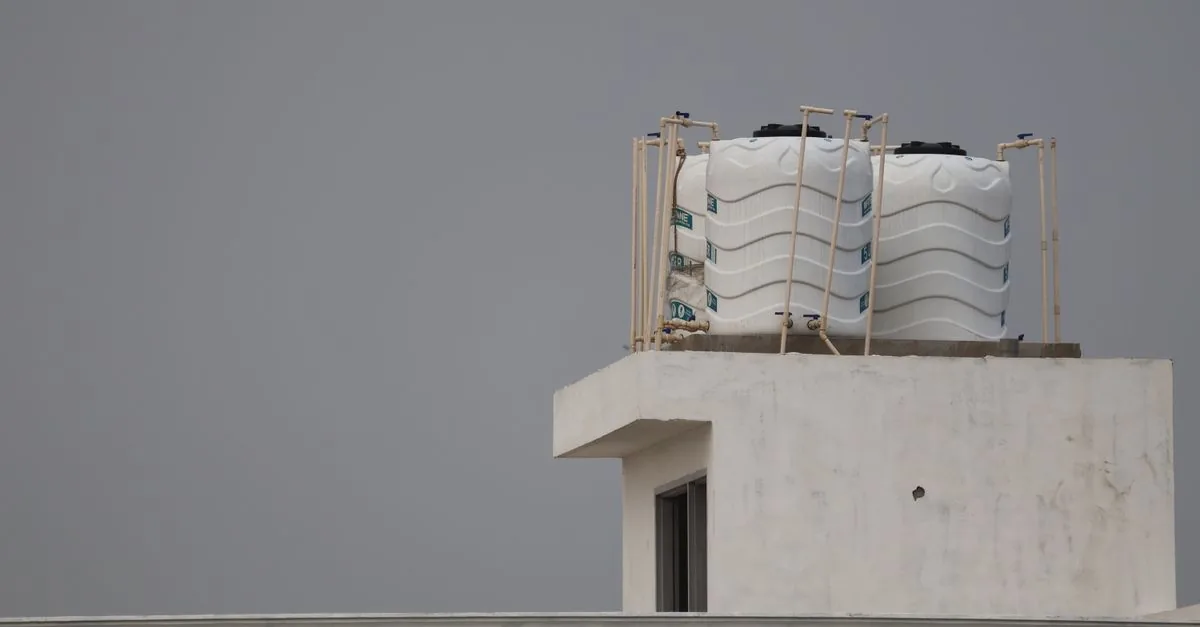
Most people in Delhi NCR remember their water tank exists twice: when the water starts smelling, and when someone in the house keeps falling ill and nobody can work out why. By then the tank has usually spent a year quietly collecting a layer of silt, algae and biofilm at the bottom, and every tap in the house has been drawing water straight through it.
So this guide does two things. It publishes what independent cleaners across NCR typically charge to clean a tank in 2026, and — more usefully — it explains the one number that actually decides your bill (the tank's capacity), the difference between an overhead tank and an underground sump, and how often this genuinely needs doing in a city with Delhi's dust, hard water and monsoon.
A note on these numbers. XpertWorker is a marketplace, not a cleaning company. We do not set any professional's price and we never charge you a paisa. Every figure in the table is an indicative Delhi NCR market range for 2026 — a yardstick for judging a quote, not a quote itself. The cleaner you choose is an independent local professional, not our employee; they set their own price, quote you free before starting, and are paid by you directly.
In this guide
- Water tank cleaning price list — Delhi NCR, 2026
- What size is your tank? (500 L, 1000 L, 2000 L and sumps)
- Why capacity is the number that decides the price
- Overhead tank vs underground sump — not the same job
- How often should you clean a tank in Delhi?
- What a proper tank clean actually involves
- What to check before you pay
Water tank cleaning price list — Delhi NCR, 2026
These are the ranges independent cleaners across Delhi NCR generally quote in 2026. The headline figure is for a standard household tank; where you land inside the range depends mostly on how big the tank is, whether it is on the roof or buried underground, and how bad the sediment has got since the last clean. The related home deep-cleaning jobs are here because tank cleaning is very often booked alongside a larger clean — but each is a separate job with a separate quote.
| Job | Typical market range | What it usually includes |
|---|---|---|
| Water tank cleaning (up to 1,000 L) | ₹600–1,500 | The common household overhead tank. Bigger tanks and buried sumps sit above this band — capacity is what moves the number |
| Full home deep cleaning — 2BHK | ₹2,500–4,500 | For context — the whole-home clean people often schedule at the same time. A different job entirely |
| Bathroom deep cleaning (per bathroom) | ₹400–900 | Descaling and hard-water limescale removal — the visible cousin of the problem your tank causes upstream |
| Kitchen deep cleaning | ₹800–2,000 | Degreasing the room your drinking water ends up in. Frequently bundled with a tank clean before a function |
Indicative Delhi NCR market ranges, 2026. Each professional sets their own charge and quotes you free before starting. Parts are normally billed on top of labour.
Want a real quote for your own job?
Get free quotesWhat size is your tank? (500 L, 1000 L, 2000 L and sumps)
Almost every search for this job includes a number — 500 litre, 1000 litre, 2000 litre. That is the right instinct, because capacity is the main thing that moves the price. Here is how to read your own tank before anyone quotes you.
Most Delhi flats have a black or white plastic overhead tank (Sintex is the name people use for all of them) sitting on the roof. The capacity is moulded into the side, usually near the top, in litres. If you cannot find it, the common domestic sizes are 500, 750, 1000 and 2000 litres, and a 1000-litre tank is roughly a metre across.
| Tank | Typical home | What to expect on price |
|---|---|---|
| 500 L overhead | 1BHK, small family | The lower end of the household band — less water to drain, less surface to scrub |
| 1000 L overhead | Most 2–3BHK Delhi flats. The commonest size by far | The band below is quoted for exactly this — it is the standard domestic job |
| 2000 L overhead | Larger floors, small shared buildings | Above the band. Expect roughly one and a half to two times a 1000 L clean — it is more drain time, more scrubbing and more rinse water |
| Underground sump | Independent houses, buildings with a booster pump | Highest. Confined space, a pump needed to empty it, and often two people for safety — see the section below |
| Society / common tank | Shared roof tank for a whole building | Quoted per job after inspection. Never take a phone quote on one of these |
One honest caveat about every "price list" you will find for this job, including ours: the household band below is quoted for a standard overhead tank up to 1,000 litres. Anything bigger, buried, or badly neglected is quoted after someone has looked at it. A firm number given over the phone for a tank nobody has seen is a number that will change on the day.
Why capacity is the number that decides the price
Ask three cleaners what tank cleaning costs and you may get three very different answers — not because anyone is overcharging, but because "a tank" can mean anything from a small 500-litre loft tank to a 5,000-litre underground sump feeding a whole building. The work scales with the water.
A larger tank means more square footage of wall and floor to scrub by hand, more sediment to shovel and bail out, more disinfectant, and — the part people forget — more clean water wasted in the flush-and-rinse at the end. That is why the range above is pinned to a capacity ("up to 1,000 L"): it is the only honest way to quote this. When you ask for a price, the first thing a good cleaner will ask you back is "how many litres, and where is it?" If they quote a flat number without asking, they are guessing.
- Know your litreage before you call. It is usually moulded onto the side of a plastic (Sintex-type) tank, or printed on the original bill. A rough size beats "the normal one".
- Count your tanks. Many NCR homes have more than one — a roof tank plus an underground sump, sometimes a separate tank per floor. Each is priced on its own.
- Access changes the number. A roof tank you can stand next to is easy. A sump under a driveway with a heavy slab lid, or a tank wedged into a low loft, is slower and harder work, and the quote will reflect it.
Overhead tank vs underground sump — not the same job
Almost every NCR home runs a two-stage system: municipal or tanker water arrives and collects in an underground sump, a pump lifts it to an overhead tank on the roof, and gravity feeds it down to your taps. Both need cleaning, and they are genuinely different jobs.
The overhead tank is the one most people picture. It is smaller, it is where sunlight, roof heat and airborne Delhi dust breed algae fastest, and it is the last thing your water touches before it reaches you — so it matters most for taste and smell. It is also usually the easier of the two to clean, being accessible and off the ground.
The underground sump is a different animal. It is bigger, it is dark and damp, it collects the grit and sediment that settles out of tanker and mains water first, and getting into it can mean lifting a heavy slab and working in a confined space. Because it holds more water and is harder to access, a sump clean sits above an overhead tank of the same nominal size, and it is worth having done even though you never see inside it — because everything in your overhead tank passed through the sump first.
If your water quality has dropped, the honest answer is usually both need doing, and doing only the roof tank while the sump stays dirty is a half-measure that does not last. When you ask for a quote, say clearly whether you want the overhead tank, the sump, or both — it is the single biggest driver of the price after litreage.
How often should you clean a tank in Delhi?
The widely accepted answer for a city like Delhi is at least twice a year, and the calendar reason is the monsoon.
Do one clean just before the monsoon (roughly May–June) so the tank goes into the wet season empty of the winter's accumulated sediment, and a second just after it (around September–October) to clear out whatever the rains, the humidity and any contaminated supply pushed in. In between, several things specific to NCR are working against you the whole time:
- Dust. Delhi's air is heavy with fine particulate for much of the year, and any tank whose lid does not seal perfectly is letting it settle into the water.
- Heat and algae. A black or dark plastic tank on an exposed roof in a 45°C summer is an incubator. Algae and biofilm form a slick green-brown film on the walls that no amount of "it looks fine" makes safe.
- Hard water. Most of NCR runs on hard groundwater, so mineral scale builds up alongside the biological growth — the same limescale you fight on taps, tiles and glass is coating the inside of your tank.
- Interrupted and tanker supply. Where the mains is patchy and tankers fill the gap, water quality varies load to load, and sediment accumulates faster.
Twice a year is the floor, not the ceiling. A household on tanker water, a tank with a cracked or missing lid, a building with a lot of construction dust nearby, or anyone who has noticed a change in taste, colour or smell should clean more often. If you genuinely cannot remember the last time it was done, treat that as a sign it is overdue.
What a proper tank clean actually involves
Tank cleaning is not "tip in some bleach and let it sit". A job worth paying for is a physical one, and knowing the steps lets you tell whether you got the clean you paid for or just a quick rinse.
- Draining. The tank is emptied out. A conscientious cleaner will try to time this for when the tank is already low so that clean water is not simply dumped down the drain — worth agreeing beforehand.
- Sludge removal. The silt, grit and sediment that has settled at the bottom is scooped and bailed out by hand. This is the heavy, dirty part and it is the reason a big tank costs more than a small one.
- Scrubbing. The walls, floor and corners are scrubbed to lift off the algae, biofilm and mineral scale. This is manual, mechanical work — brushes, and sometimes a high-pressure jet. It is the step that actually removes the contamination.
- Vacuuming or sponging out. The loosened muck and dirty rinse water are removed, often with a wet vacuum, so it is not left to redistribute.
- Disinfecting. The clean surfaces are treated with a food-safe sanitiser to kill remaining bacteria, then the tank is flushed so no chemical residue is left in your drinking water.
- Refill and check. The tank is refilled, and the lid and any mesh or overflow is checked — a tank with a broken lid will be dirty again in weeks, so this step is not optional.
Manual scrubbing vs "chemical only". Be wary of anyone offering to clean a tank purely by adding chemicals without emptying and scrubbing it. Chemicals disinfect; they do not physically remove a bottom layer of silt or a wall coating of biofilm. A real clean needs the tank emptied and scrubbed by hand — the disinfectant is the finishing step, not the whole job.
What to check before you pay
This is a job you can and should inspect, because the whole point of it is invisible once the lid is back on. A few minutes at the right moment is the difference between a clean tank and a clean receipt.
- Look inside before they close it. Ask to see the empty tank after scrubbing and before refilling. The walls and floor should be visibly clean — no green film, no sludge in the corners, no slick to the touch. This is the one check that matters most.
- Confirm it was emptied and scrubbed, not just dosed with chemicals. If the water was never fully drained, it was not properly cleaned.
- Ask which tanks are included. Overhead only, sump only, or both — and get it agreed before work starts, because "I thought the sump was included" is the classic dispute.
- Ask about the lid. A good cleaner will point out a cracked, warped or missing lid or a torn overflow mesh — the things that let dust and insects straight back in. Fixing the lid is what makes the clean last.
- Agree the quote covers the actual capacity. The price is tied to litreage, so make sure the number you were quoted matches the tank you actually have, not a smaller assumed one.
- Pay the cleaner directly, after the work. Never pay an advance to a platform or an agent. You deal with the professional and settle with them.
If you want quotes for your specific tank, you can request them from independent cleaners on XpertWorker and compare. We never charge you anything and we do not set anyone's price — you tell the cleaner your tank size and location, they quote you free, and you pay them directly.
Need an Home Cleaning professional?
Get free quotes from independent, local professionals near you. XpertWorker never charges you — you pay the professional directly.
Get free quotes →Frequently asked questions
What is the price for cleaning a 1000 litre water tank in Delhi?
Is my tank overhead plastic or an underground sump — and does it change the price?
Can I clean a water tank myself instead of paying someone?
How much does water tank cleaning cost in Delhi NCR?
How often should a water tank be cleaned in Delhi?
Is cleaning an underground sump more expensive than an overhead tank?
Can a tank be cleaned with chemicals only, without scrubbing?
Why does dirty tank water matter for health?
Does XpertWorker do the cleaning or set the price?
How we put this guide together
The ranges in this guide are indicative market rates compiled from real jobs across Delhi NCR and reviewed by the XpertWorker pricing desk. They are not quotes, and they are not our prices — every independent, local professional sets their own charge and quotes you free before any work starts.