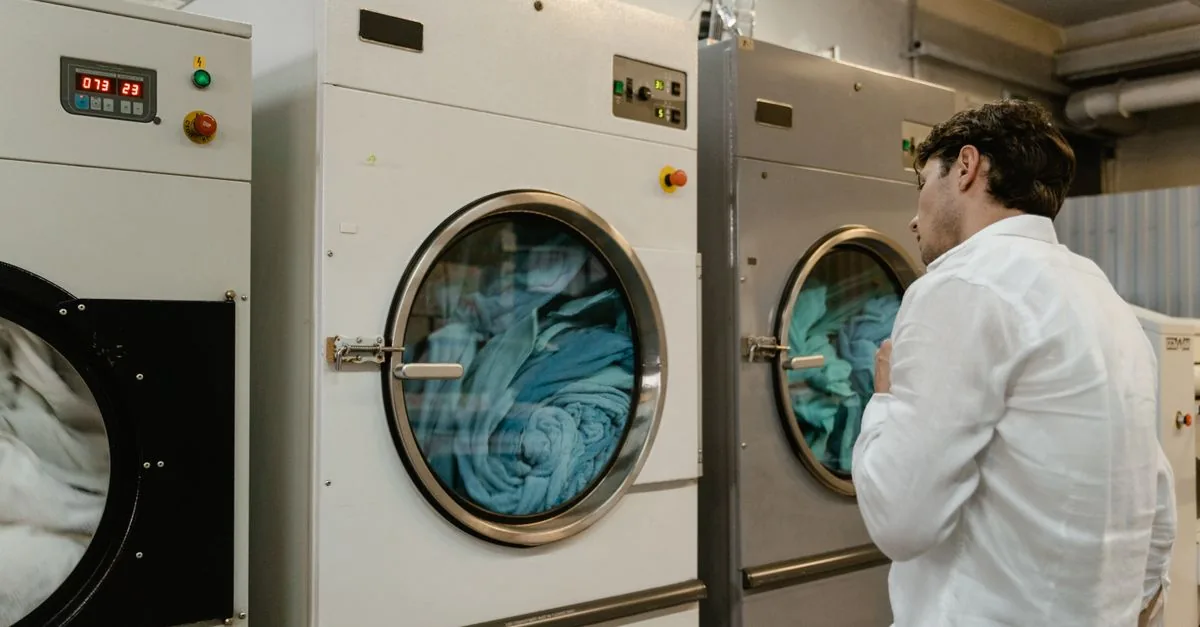
Before anything else, separate two different faults that look identical from the outside. If there is still water in the drum, your machine is not draining, and the spin is being blocked on purpose — almost every machine refuses to spin until the water is out. That is a different problem, and our guide on a washing machine that will not drain covers it.
This page is about the other case: the water goes out normally, but the drum never gets up to speed, or it turns slowly and gives up. That points at load balance, a safety switch, a belt or the motor — in that order of likelihood.
A note first. XpertWorker is a marketplace, not a service company. We do not set any professional’s price and we never charge you a paisa. Every professional quotes you free before starting, and you pay them directly.
In this guide
Is the load unbalanced?
This is the most common cause by a wide margin, and it costs nothing to rule out. A machine that detects an unbalanced drum will slow down, try again, and eventually stop rather than shake itself across the floor.
- Open it and redistribute the clothes by hand. One heavy item — a bedsheet, a curtain, a pair of jeans — wraps into a lump on one side. Spread everything around the drum evenly and restart the spin.
- Do not wash a single heavy item alone. One blanket on its own is the classic trigger. Add two or three towels so the load can settle evenly.
- Do not overload. An overpacked drum cannot tumble, so the machine never gets a balanced load to spin. If clothes are pressed to the top of the drum, take a third out.
- Check the machine is level and standing on all four feet. Push each top corner. A machine that rocks on an uneven Delhi bathroom or balcony floor will trigger the imbalance protection on loads that would otherwise be fine. Adjust the feet until it does not move.
- Front loaders: check the transit bolts. On a newly delivered machine, the shipping bolts at the back must be removed. Left in, the drum cannot move at all and the machine will bang violently or refuse to spin.
Want a real quote for your own job?
Get free quotesIs the lid switch or door lock working?
No machine will spin at full speed with the door open, and it decides that using a switch. When that switch fails, the machine behaves exactly as if the door were open — it fills, it washes, it may drain, and then it simply will not spin.
- Top loaders. There is a small plunger and switch where the lid meets the body. Close the lid firmly and listen for a click. If the lid is warped, or the plastic plunger has broken off, the machine thinks the lid is open forever.
- Front loaders. The door lock clicks audibly a few seconds after the cycle starts. If you can open the door mid-cycle, or the machine never clicks, the interlock is faulty. A worn door seal that lets the door sit slightly proud has the same effect.
- Semi-automatic machines. The spin tub has its own lid switch and often a separate spin timer knob. If the wash tub works but the spin tub does nothing, test whether the spin motor hums at all with the lid closed properly.
Is water still sitting in the drum?
If there is any standing water, the machine is doing the right thing by refusing to spin. Fix the drainage and the spin usually returns on its own.
- Check the drain hose. The most common problem in Indian flats is a hose pushed too far down a floor drain, or looped in a way that creates a siphon. It should discharge freely and not be submerged in standing water.
- Clean the drain pump filter. On front loaders this is a small screw-out cap behind a flap at the bottom front. Coins, hairpins, lint and safety pins collect there. Put a shallow tray and a towel down first, because water will come out.
- Check the floor drain itself. In many Delhi bathrooms the machine drains into a floor trap that is itself half blocked with hair and detergent scum. The machine gets blamed for a plumbing problem.
Full detail is in our washing machine not draining guide.
Belt, motor or control board — how to tell them apart
If the load is balanced, the door locks, and the water is gone, the fault is mechanical or electrical. You can narrow it down without opening anything, just by listening.
- The motor runs but the drum does not turn. Classic broken or slipped drive belt on a belt-driven machine. You will hear the motor speed up with nothing happening in the drum. Common on older top loaders and semi-automatics.
- The drum turns slowly and never picks up. Often worn motor carbon brushes on machines that use a brushed motor, or a belt that has stretched and is slipping. Slipping belts sometimes give a hot rubber smell.
- Complete silence when the spin should start. Points at the control board, the motor itself, or the safety switch not letting it start. Note whether the display shows an error code — that code narrows the diagnosis enormously, so photograph it.
- A hum, then nothing, repeatedly. The motor is being told to run and cannot. Could be a seized drum bearing, a jammed item wedged between drum and tub, or a start capacitor on a semi-automatic. Stop and call someone rather than repeating it.
- Loud grinding as it tries to spin. Likely a drum bearing, which is one of the bigger jobs on any washing machine. Our washing machine noise guide covers how to identify it.
Do not open the back panel yourself. The capacitor in a washing machine can hold a charge after the machine is unplugged, and the wiring sits next to water.
What makes this fault more common in Delhi
Three local conditions shorten the life of exactly the parts involved in spinning.
- Very hard water. Scale builds on the drum, the heater and the bearings’ seal area. It also encourages people to use more detergent, which leaves residue that stiffens seals. Machines in hard-water areas of Delhi and Gurgaon see bearing and seal trouble earlier. Our hard water tips cover what actually helps.
- Water supply that runs only a few hours a day. Many households run three or four loads back to back in the supply window. Continuous heavy use is far harder on belts, motors and bearings than the same number of loads spread over a week. If you must batch, put a break between loads.
- Voltage fluctuation. The control board and motor electronics on a modern automatic machine do not enjoy dips and spikes. If your area has an unstable supply, treat unexplained board failures as a symptom of that, not bad luck.
- Machines on balconies. Very common here, and it means dust, sun and monsoon damp on the electronics. A cover when not in use genuinely extends the life of the board.
If you do end up needing a repair, our washing machine repair cost guide explains what drives the difference between a small job and a big one.
Need an AC & Appliance Repair professional?
Get free quotes from independent, local professionals near you. XpertWorker never charges you — you pay the professional directly.
Get free quotes →Frequently asked questions
Why is my washing machine not spinning but the water drains?
Why does my washing machine stop before the spin cycle?
How do I know if my washing machine belt is broken?
Can I use a washing machine if it will not spin?
Why does my washing machine shake violently when spinning?
Does hard water damage a washing machine?
How we put this guide together
This guide is compiled from common Delhi NCR service patterns and reviewed by the XpertWorker team. XpertWorker connects you with independent, local professionals — we never charge you a paisa, and each professional sets their own price and quotes you free.