Two things make an RO leak look worse than it is. The unit sits on a wall or a shelf, so a slow drip lands somewhere obvious and spreads. And an RO is full of thin plastic tubes pushed into collet fittings, so a leak that starts as a bead on a joint travels down the tube and drips off the lowest corner — which is almost never where it began.
So the job is not "stop the drip", it is "find the joint". Dry everything, watch where the first bead reappears, and you have usually identified the fault in ten minutes without tools. The commonest answers in Delhi flats are a push-fit tube that was never seated fully at the last service, a filter housing that was hand-tightened but not seated on its O-ring, a faucet spindle worn by hard water, and — less often — a storage tank whose internal bladder has given up. Some of what people report as a leak turns out to be condensation.
A note first. XpertWorker is a marketplace, not a service company. We do not set any professional’s price and we never charge you a paisa. Every professional quotes you free before starting, and you pay them directly. This page names no figure at all — when you want indicative ranges, our RO repair cost guide for Delhi carries them.
In this guide
- First: switch it off at the socket and close the inlet valve
- RO leaking from the bottom? Start with the push-fit tube joints
- RO dripping continuously from the tap: the faucet spindle and the filter housings
- The storage tank, and the leak that is not a leak
- When to call a technician, and what to tell them
First: switch it off at the socket and close the inlet valve
Do this before you investigate anything. It costs nothing, it takes a minute, and it stops the leak getting worse while you work out what it is.
- 1. Switch the purifier off at the wall socket and pull the plug. The unit is a mains appliance with a pump inside it, and there is now water where water should not be. Killing the power first is not optional. Do not open anything with the plug still in.
- 2. Close the inlet valve. There is a small tap or angle valve where the feed line branches off — usually under the sink, on the wall behind the unit, or at the tap the purifier is plumbed into. Turn it clockwise until it stops. With power off and inlet closed, the machine cannot make more water and cannot push any more out of the leak.
- 3. Drain the tank if the leak is heavy. Open the purifier faucet and let it run into a bucket until it stops. A stored tank keeps feeding a leak long after the power is off.
- 4. Dry the whole area completely. Wipe the base tray, the wall behind, the shelf and every tube you can reach. This is the step people skip and it is the one that finds the fault.
- 5. Now open the inlet again, plug in, and watch. Stand and watch for two or three minutes with a torch and a tissue. Touch the tissue to each joint in turn. The first joint that wets the tissue is your leak, regardless of where the puddle was.
If the alarm is sounding as well as leaking, that is very likely the leak sensor in the base tray doing its job — see why an RO beeps for what the other alarms mean. Do not silence a leak alarm and carry on.
Want a real quote for your own job?
Get free quotesRO leaking from the bottom? Start with the push-fit tube joints
This is the commonest leak in a domestic RO, and it is also the cheapest to put right.
Inside the cabinet, the thin plastic tubes are held by push-fit collet fittings. A tube is pushed into a small ring, tiny teeth grip it, and an O-ring inside the fitting makes the seal. For that seal to work the tube has to go in all the way — past the teeth and home against the shoulder. A tube pushed in most of the way looks perfectly fitted from outside and holds for weeks, then starts weeping under pump pressure.
How to recognise it:
- The leak appeared within a few weeks of a service or a filter change. That is the classic signature. Somebody pulled tubes off to swap a cartridge and did not push one fully back.
- It weeps rather than runs. A bead forms at the collar of a fitting, grows, and drips off. Between drips it looks dry.
- It is worse when the pump is running and slows or stops when the tank is full and the machine shuts off. Pressure-dependent leaks are joint leaks.
- The tube end looks scored, oval or kinked. A tube that has been pulled out and re-pushed several times gets chewed by the teeth and will not seal again. It needs the damaged end cut off square, or the tube replaced.
Is this DIY? Partly. Pushing a visibly loose tube fully home, with the power off and the inlet closed, is reasonable and often fixes it outright. Cutting tube ends square, replacing a fitting, or working out which of a dozen identical tubes is at fault is a technician job — and if you are not confident which line is which, leave it. Getting a tube back into the wrong port turns a drip into a much bigger mess.
RO dripping continuously from the tap: the faucet spindle and the filter housings
If the water is coming out of the purifier’s own faucet rather than from under the cabinet, that is a different fault with a different fix. And if it is coming from the fat cylindrical filter bodies, that is a third.
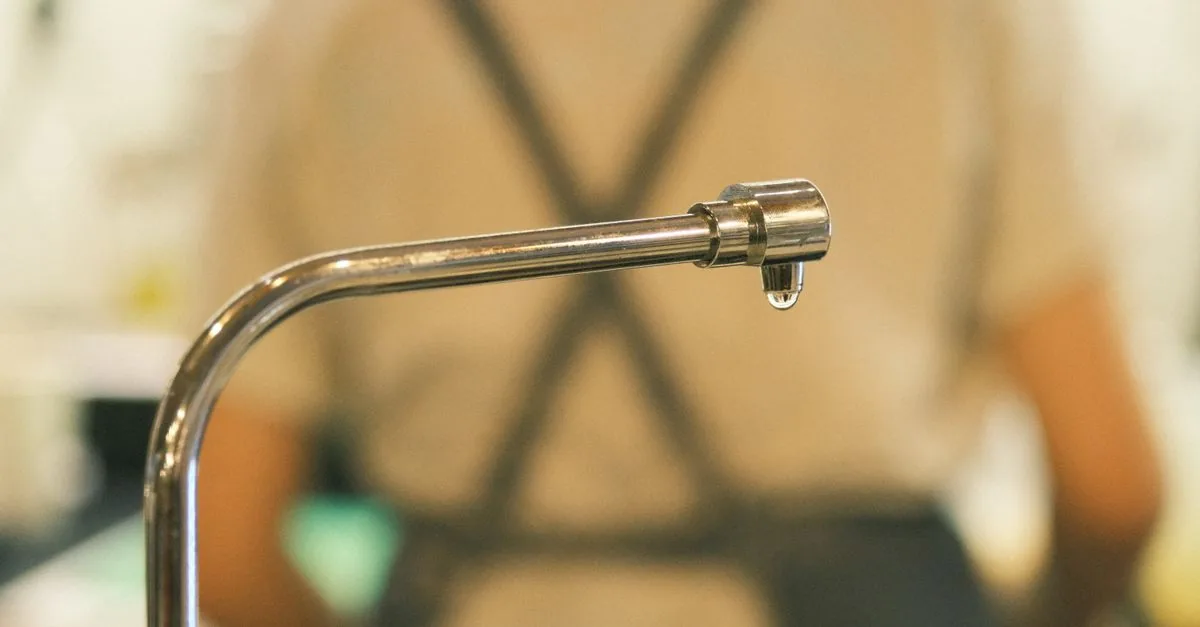
- The faucet spindle or washer. The small dedicated tap that came with the purifier is a mechanical valve like any other, with a spindle and a seal that wear. A steady drip that continues after the handle is fully closed, and that keeps going with the machine switched off but the tank full, is the faucet, not the RO. In Delhi this wears faster than it should: hard water leaves scale on the seat, the seal cannot close against a rough surface, and the drip starts. It is a cheap part and a quick job. The same mechanism in a normal household tap is covered in our tap and mixer repair guide.
- Filter housings not tightened. The pre-filter and carbon housings screw into a cap. If one was not tightened properly at the last service — or was cross-threaded — it seeps from the join between the bowl and the cap. The tell is water running down the outside of the housing itself, and a dry cabinet everywhere else.
- A perished or displaced housing O-ring. Each housing seals on a thick rubber O-ring sitting in a groove. Over a few years that ring goes hard, flattens and cracks; it can also be pinched or left out of its groove during a hurried filter change. A housing that leaks even when it is properly tight is telling you the O-ring is finished. Replacing it is a routine part of a competent service, and it costs very little — which is why it is worth insisting on rather than accepting a housing that "just weeps a bit".
- The drain line or the waste tube. An RO sends a continuous flow to drain while it is making water, and that is normal, not a leak. What is not normal is the drain tube having worked loose from its clip and spilling into the cabinet instead of down the waste pipe. How much goes to drain in the first place is a separate question, and some discharge while the machine runs is by design rather than a fault.
The Delhi-specific bit. Almost everything on this list wears faster here because of hard water. Scale on a faucet seat, chalky white crust on a housing thread, an O-ring that has gone stiff and shiny — those are the same deposits that fur up your geyser and your kettle. Our hard water tips for Delhi homes covers the habits that slow it down.
The storage tank, and the leak that is not a leak
Two causes left, and they are the two people most often get wrong in opposite directions — one is dismissed when it is real, the other is treated as a disaster when it is nothing.
The storage tank bladder. Inside the plastic storage tank there is a flexible bladder with air pressure behind it; that stored air is what pushes water out of the faucet when you open it. When the bladder splits or the seam around the tank shell fails, water gets into the air side and the tank starts to weep — often from the seam around its middle, or from the port where the tube enters. Recognise it by these signs together: the leak is at the tank rather than the cabinet, the faucet flow has gone weak and stops early even though the tank should be full, and the machine runs more often than it used to. A failed tank is a replacement, not a repair; there is nothing serviceable inside it. If the flow problem is the main symptom and there is no water anywhere, read RO not filling the tank first, because a weak delivery has several other causes.
Condensation mistaken for a leak. This one is genuinely common in Delhi and worth knowing before you pay anyone. In July and August, when the air in the kitchen is warm and very humid, a tank and the tubes full of cool water behave like a cold drink glass: moisture from the air condenses on the outside and runs down. You get a damp patch under the unit and a wet tank that has nothing at all wrong with it. Tell them apart like this:
- Dry the tank and tubes completely, then watch. Condensation returns as an even film over a whole cold surface. A leak returns as a bead at one point.
- Follow the wetness to a source. Condensation has no source joint. If you cannot find a joint that is wetter than its surroundings, you probably do not have a leak.
- Note the season and the weather. A damp patch that shows up in the monsoon, disappears in November and comes back next July is condensation. A leak does not care what month it is.
- Check the quantity. Condensation makes a damp patch. A real leak makes a puddle that refills after you mop it.
When to call a technician, and what to tell them
Call someone when any of these is true. There is no shame in the list — several of them are simply not worth your afternoon.
- You cannot find the source joint after drying everything and watching it run.
- The leak is at a housing that is already tight — that is an O-ring, and the right ring for your housing is a part they carry.
- A tube end is damaged, or a fitting weeps after being pushed home properly.
- The tank is weeping, or the faucet flow has gone weak and short. That is a tank replacement.
- The socket, plug or the wall behind them got wet. Stop entirely. Do not switch anything on. This is now an electrical question and belongs with a professional, not with you.
- The leak is upstream of the purifier — at the inlet valve, the wall connection or the flexible feed line. That is plumbing rather than purifier work.
What to tell them on the phone, so they arrive with the right part:
- Make and model, from the sticker on the side or back.
- Exactly where the first bead of water forms — a tube joint, a housing, the tank, the faucet, or somewhere you cannot see.
- Whether it leaks only when the pump runs, or also when the machine is off with a full tank.
- When it was last serviced, and whether the leak started soon afterwards.
- Whether the faucet flow has changed, and whether the machine now runs more often.
- Whether any alarm is sounding.
For indicative ranges across the city, see our RO repair cost guide for Delhi, the RO service cost and TDS guide for Delhi NCR and, if a membrane comes into it, the membrane replacement guide. This page names no figure on purpose: the professional you choose sets their own price and quotes you free before starting. If the machine has other symptoms alongside the leak, start at RO not working, and if it has also become noisy, see RO making noise.
Need an Water Purifier professional?
Get free quotes from independent, local professionals near you. XpertWorker never charges you — you pay the professional directly.
Get free quotes →Frequently asked questions
Why is my RO leaking water from the bottom?
Why is my RO faucet leaking or dripping continuously?
My water purifier started leaking right after a service. Why?
Should I switch the RO off if it is leaking?
Is water under my RO always a leak?
Does XpertWorker charge me for an RO repair, or set the price?
How we put this guide together
This guide is compiled from common Delhi NCR service patterns and reviewed by the XpertWorker team. XpertWorker connects you with independent, local professionals — we never charge you a paisa, and each professional sets their own price and quotes you free.