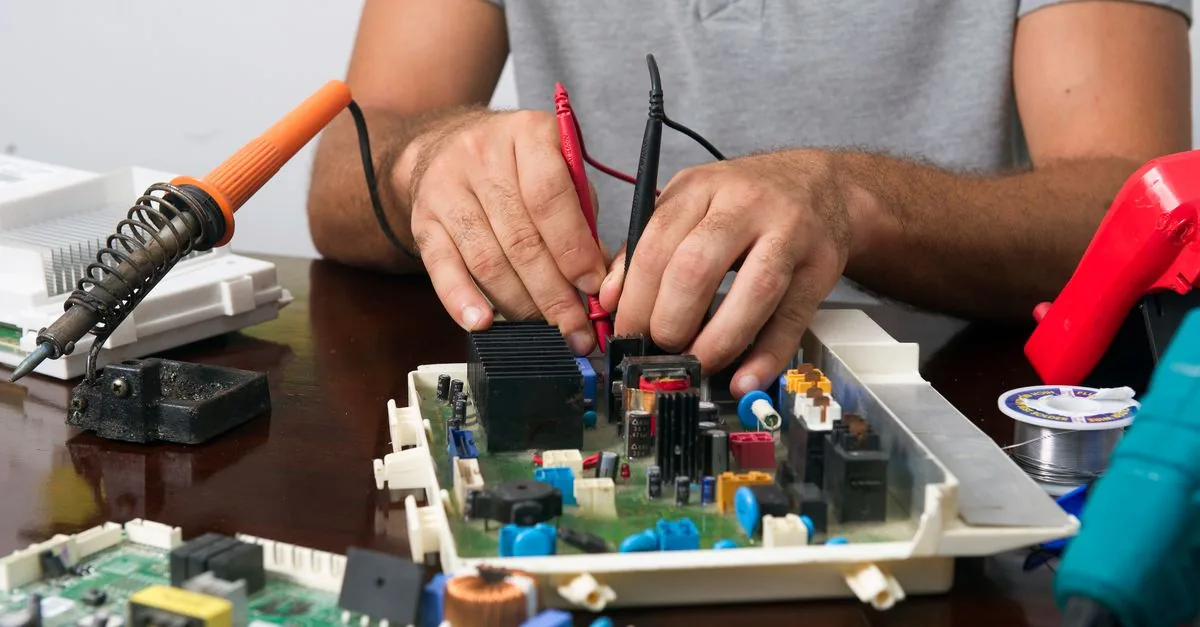
An inverter that will not charge is usually discovered at the worst possible moment: the middle of a long summer cut, when it should have been carrying the fans. The panic then leads people straight to buying a battery, which is the most expensive guess available and quite often the wrong one.
Before spending anything, it is worth separating the three real possibilities. Either mains power is not reaching the inverter at all, or the inverter is receiving power but not passing charge to the battery, or the battery has simply reached the end of its life and cannot hold what it is given. Each one has a different tell, and you can find all of them for free.
What is safe here and what is not. Checking indicators, unplugging, switching a breaker, looking at the battery and smelling for trouble are all safe. Opening the inverter, changing its internal fuse, or disconnecting and reconnecting battery terminals is not — battery terminals can deliver an enormous current into a spanner, and the inverter output stays dangerous even during a power cut. Leave all of that to a professional.
A note first. XpertWorker is a marketplace, not a service company. We do not set any professional’s price and we never charge you a paisa. Every professional quotes you free before starting, and you pay them directly.
In this guide
First: is mains power actually reaching the inverter?
Start here, because this is the free fix and it is more common than people expect. An inverter that is not being fed cannot charge, and it will happily sit there looking switched on while running the house off the battery until the battery is flat.
- Look at the indicator panel. Almost every inverter shows mains present separately from charging. If the mains lamp is dark while the colony clearly has power, the input side is your problem, not the battery.
- Check the socket or circuit that feeds it. If the inverter plugs into a wall socket, is that socket switched on and working? Try a lamp in it. Our guide on a socket that has stopped working covers the usual reasons a single point goes dead.
- Check the breaker for that circuit at the distribution board and reset it once if it has tripped. If it trips again, stop and read why an MCB keeps tripping.
- Check the inverter’s own mains switch if it has one on the body, and the switch on the trolley or the wall isolator next to it. These get knocked off during cleaning surprisingly often.
- Consider the obvious one in a Delhi summer: if cuts are long and frequent, the inverter may simply not be getting enough hours of mains to complete a charge. That is not a fault, it is arithmetic, and it is the single most common false alarm.
If the mains lamp is on and the charging lamp never comes on, move to the next section.
Want a real quote for your own job?
Get free quotesIs it the battery? The signs you can see without tools
Batteries wear out gradually and then fail suddenly, and there is almost always a warning period that gets ignored. Look for these.
- Age. A domestic inverter battery in Delhi heat has a finite life measured in a few years, not many. If yours is old and the backup has roughly halved, the battery is the likely answer regardless of what else you find.
- Backup that has been shrinking for months. An inverter that used to run the fans all evening and now manages an hour is describing a battery, not a charger.
- Electrolyte level below the mark on a flooded battery with caps on top. Plates that have been dry, even for a few weeks in summer, do not fully recover. Top-ups are distilled water only, never tap or RO water.
- White, blue or green crust on the terminals. Corrosion adds resistance, and enough of it stops proper charging. It needs cleaning by someone who knows how to do it safely.
- A swollen or bulging case, a strong rotten-egg smell, or a battery that is hot after charging. Stop, keep the area ventilated, keep flames away and get it looked at. Do not keep charging it.
- It charges to full in minutes. Counter-intuitive but classic: a battery with failed cells shows full voltage almost immediately and then collapses the moment any load is applied.
Is it the inverter itself?
If mains is present, the battery is reasonably young and its levels look fine, the charging side of the inverter is the remaining suspect. You cannot repair this yourself, but you can describe it accurately, which is worth a lot.
- Mains lamp on, charging lamp never on. The classic charging-section fault. Note whether it was preceded by a storm, a voltage surge or a long cut.
- It charges only sometimes, or only at night. Many inverters refuse to charge when the incoming voltage is outside their acceptable window. On a Delhi summer afternoon the supply sags badly, and a unit set to a narrow window will simply wait. If it charges happily at midnight and never at 4pm, that is this.
- It keeps switching between mains and battery every few seconds. Usually an unstable supply or a loose connection, and it is hard on both the inverter and the battery.
- Continuous beeping, a burning smell, or a hot body. Switch it off and stop using it. That is not a diagnosis to sit on.
- Nothing on the panel at all while the socket feeding it is confirmed live. Usually an internal fuse or a failed board, and neither is a home repair.
Worth knowing: after a long Delhi cut, a badly discharged battery can take many hours to show any progress, and some inverters charge at a deliberately low rate to protect the battery. Give it a full day of steady mains before concluding the charger is dead.
The free checklist to run before you call anyone
Ten minutes, no tools, nothing opened. Write down what you find.
- Which lamps are lit on the inverter panel, and which are not. Photograph the panel.
- Does a lamp work in the socket that feeds the inverter?
- Has any breaker tripped at the distribution board?
- How old is the battery, and how much backup did it give last year compared with now?
- Water level and terminal condition — looked at, not touched.
- Any smell, heat, bulging or noise from the battery or the inverter.
- Does the behaviour change with the time of day? This is the Delhi voltage question and it is the one nobody thinks to check.
Handing that list to an electrician turns an open-ended visit into a targeted one. It also makes it much harder for anyone to sell you a battery you did not need. If a new battery genuinely is the answer, our inverter and battery installation guide covers what the job involves, and power cut and inverter tips covers the maintenance that makes the next one last longer.
When to call someone, and what to ask for
Call today if the battery is bulging, hot or smelling, if anything is burnt or beeping continuously, if a breaker keeps tripping when the inverter is connected, or if anyone has felt a tingle from the inverter body or the trolley.
For an ordinary no-charge complaint, ask for these three things specifically:
- A load test on the battery, not just a voltage reading. A dying battery shows a healthy voltage at rest and collapses under load. Any diagnosis based only on a resting reading is not a diagnosis.
- A check of the incoming voltage at the inverter, taken in the afternoon if that is when it refuses to charge. This is how the Delhi voltage-window problem gets caught.
- A clear statement of which of the three parts has failed — input supply, charging section, or battery — before you agree to buy anything.
If the answer is a new battery, ask for the old one to be taken away properly. And if it turns out the inverter socket or its circuit is the fault, that is ordinary electrical work — see electrician charges in Delhi NCR for how these visits are usually billed.
Need an Electrician professional?
Get free quotes from independent, local professionals near you. XpertWorker never charges you — you pay the professional directly.
Get free quotes →Frequently asked questions
Why is my inverter not charging the battery?
How do I know if my inverter battery is dead or the inverter is faulty?
Why does my inverter charge at night but not in the afternoon?
Can I change the inverter fuse or battery terminals myself?
How long should an inverter take to charge fully?
My inverter beeps continuously. What does that mean?
How we put this guide together
This guide is compiled from common Delhi NCR service patterns and reviewed by the XpertWorker team. XpertWorker connects you with independent, local professionals — we never charge you a paisa, and each professional sets their own price and quotes you free.