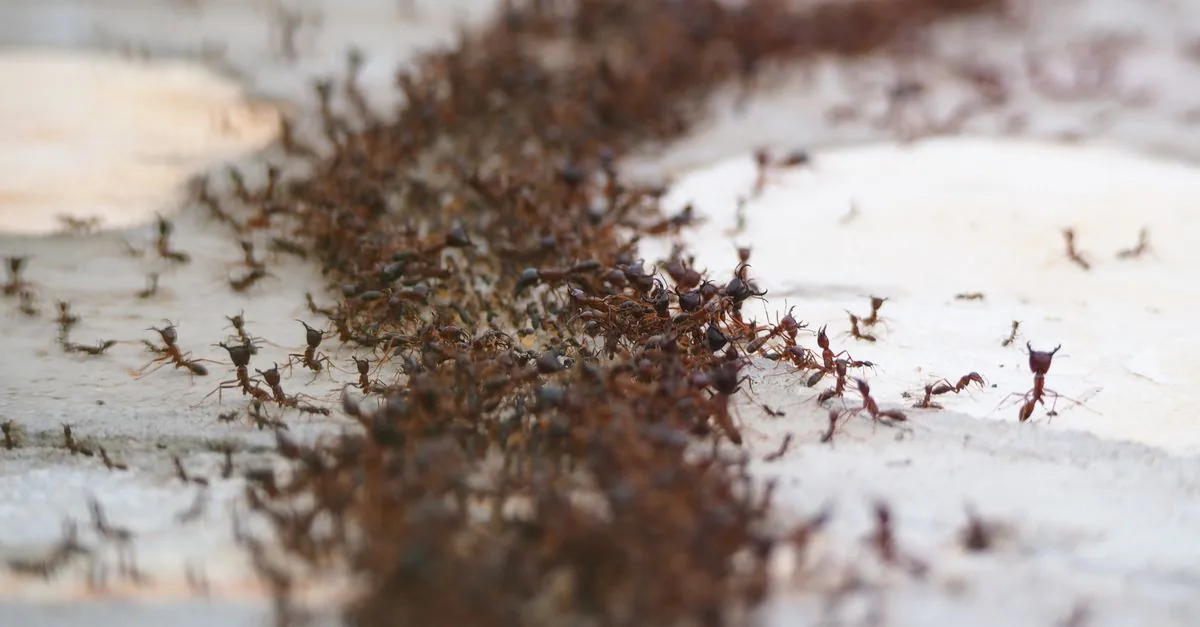
A line of ants across the kitchen counter is not a random event. It is the visible end of an organised operation: a scout found something, walked home leaving a scent trail, and the colony is now running a supply line to your sugar jar. Understand that and the whole problem changes shape, because the ants you can see are a tiny fraction of the ones you are actually dealing with.
Which is why the two things everyone does first — wiping the line away and spraying it — so often end with more trails than you started with. Spraying kills the workers on the counter and touches nothing in the nest, and a colony that senses pressure on one route simply opens two more. Weeks of this is how a five-minute problem becomes a summer-long one.
This guide goes deeper than our short kitchen ant and cockroach tips, which cover the nightly habits. Here we look at behaviour: what the trail tells you, what kind of ant you have and therefore what it wants, why bait reaches the nest when a spray cannot, where the nest actually is in a Delhi flat (balcony pot soil far more often than anyone expects), and how the problem moves through a Delhi year.
A note first. XpertWorker is a marketplace, not a service company. We do not set any professional’s price and we never charge you a paisa. Every professional quotes you free before starting, and you pay them directly. The professionals you would meet through us are independent; our checks are identity checks, not a skill test.
In this guide
Read the trail before you wipe it
The trail is free information, and it is the only free information you are going to get. Spend ten minutes on it before you touch anything — you will learn more than a whole evening of cleaning.
Here is how it works. A single scout wanders semi-randomly until it finds food. On the way back it lays a chemical scent trail. Other ants follow that trail, find the food, and reinforce the scent on their own return, so a good food source turns a faint line into a highway within an hour. When the food runs out, the trail is no longer reinforced and it fades on its own. That reinforcement loop is the entire mechanism, and every sensible tactic works with it rather than against it.
- Follow the line in both directions. One end is the food. The other end is the entry point, and that is the end that matters. It will usually run to a gap in the skirting, the edge of a tile, a window frame, the sink pipe collar, a switchboard, or straight out to the balcony.
- Note where it goes through the wall. If the trail disappears into a crack and does not reappear outside, the nest may be inside the wall cavity or under the floor tiles. That changes what you can do yourself.
- Watch what they are carrying. Ants carrying crumbs or specks are on solids; ants that stop, cluster and do not appear to carry anything are drinking a liquid, usually something sweet. That tells you which bait they will accept.
- Do not spray it, do not wipe it yet. An intact trail leads you to the entry. Once the food is removed and the entry sealed, then wipe it with soapy water or a diluted vinegar solution, which breaks the scent rather than smearing it around.
If you wipe first, you lose the map and the colony re-scouts from scratch, which is how one tidy trail becomes three untidy ones.
Want a real quote for your own job?
Get free quotesWhich ant is it, and what does it want?
You do not need a species name. You need to know what they are eating this week, because that decides which bait they will take and where the nest is likely to be.
- The tiny pale or dark ants on the sugar. The commonest Delhi kitchen ant: very small, moving in a thin steady line, all over anything sweet — sugar, jaggery, honey, syrup, a sticky jar rim, a mithai box, fruit. These colonies are often large, they nest in small voids (wall cavities, under tiles, behind skirting, in potted soil), and they split into new sub-colonies easily. That last habit is exactly why spraying scatters them.
- The ants on the oil, the dal and the leftovers. Some ants swing towards grease and protein rather than sugar, and some switch between the two depending on what the colony needs that month. This is the practical reason a sweet bait sometimes gets ignored: they are not on sugar this week. If a bait is being walked past, the food type is usually why.
- The big black ants on the balcony and window frames. Larger, faster, usually travelling alone or in a loose line rather than a dense trail. They mostly nest outdoors — in soil, under paving, in a wall crevice, in dead wood — and come in to forage. Fixing the entry point matters more than baiting for these.
- Winged ants in the pre-monsoon week. A sudden burst of flying ants around a light is a colony sending out mating flights, common in Delhi in the humid days just before or after the first rains. They are a nuisance for a day or two, but they are also a signal that a mature colony is nearby. If it happens indoors and repeats, treat it as a hint to look for the nest. Winged insects near woodwork can also be termites rather than ants — the signs of termite infestation guide shows how to tell them apart, and that is a very different problem.
One more thing worth knowing: many ants farm sap-sucking insects on plants for the sweet honeydew those insects produce. If ants are streaming up and down a balcony plant, look under the leaves. You may be dealing with a plant pest and the ants are just the customers.
Why spraying makes it worse, and baiting does not
This is the core of the guide. A spray is a tool for the ants you can see. A bait is a tool for the colony you cannot. Since the colony is where the eggs and the queen are, a spray can never finish the job, no matter how many cans you use.
When you spray a trail, three things happen. The workers on that line die, which looks like success. The scent trail is disrupted and contaminated, so the colony re-routes, often opening several new lines where you have not sprayed. And in some species, pressure on the colony encourages it to split, which is how one trail behind the toaster becomes trails at the window, the skirting and the sink. The nest itself, which may be inside a wall or in a flowerpot, is entirely untouched.
Bait works the other way around, and it depends on the ants staying alive long enough to be useful:
- Slow is the point. A bait is food mixed with something that acts slowly. The worker eats, carries some home, and shares it with other workers and the brood in the way ants normally share food. The effect spreads through the colony over days. Anything that kills the worker on the spot defeats the entire mechanism.
- Place it on the trail, not near it. Bait goes directly on the established line, or right at the entry point, in small amounts in several places. Do not move the trail to the bait.
- Do not clean the trail while baiting. This is the mistake that undoes everything. You need that scent line intact so the colony keeps walking to your bait. Clean it after activity has stopped, not before.
- Never spray where you bait. Spray residue repels ants from the bait and can contaminate it. Pick one approach per area, and for an indoor kitchen problem it should be bait.
- Expect activity to rise first. For a day or two after baiting, there are often more ants visible, because they are recruiting to a food source you deliberately provided. That is the bait working, and it is the point at which most people panic and spray it. Do not.
- If they ignore it, change the food type. A sweet bait refused often means the colony is on a protein or grease phase. Ask for a different formulation rather than doubling the quantity.
Where the nest actually is in a Delhi flat
People assume the nest is outside somewhere in the ground. In a Delhi flat, often it is not. Ants nest in almost any protected pocket that stays slightly moist, and modern flats are full of those. Work through this list in order — it is roughly the order of likelihood.
- Balcony pot soil. This is the big one. A potted plant is a perfect ant nest: loose soil, drainage holes, warmth, moisture, and a saucer that stays damp. Ant colonies set up in pots constantly across Delhi balconies, and no amount of kitchen cleaning touches them. The tell is a trail running from the balcony to the kitchen, ants boiling out when you lift or water a pot, or fine loose soil heaped at the drainage hole. Our balcony garden pest tips cover what to do with an infested pot.
- Under loose or hollow floor tiles. Tap around the kitchen and near the balcony door. A hollow-sounding tile with a cracked grout line is a classic nest void, and you will often see fine soil pushed up at the joint.
- Behind the skirting and inside wall cavities. Especially on a wall that shares a bathroom or a wet area, or one with old seepage. Damp plaster is attractive to them.
- Around the sink and the drainage pipe collar. The permanently slightly damp cavity where a waste pipe passes through the floor or wall is prime real estate.
- Behind switchboards and inside meter boxes. Dry, protected, undisturbed. This is also the one place you must not attack yourself.
- Under the AC outdoor unit, in the window channel, in the door frame. Any small void the building gave them for free.
- Genuinely outside. In a garden, under paving, along a boundary wall, or in the soil of a common-area planter. Common for the big black ants, and often not something a single flat can resolve on its own.
If the trail leads into a wall or under tiles and you cannot reach the nest, that is the honest point at which do-it-yourself baiting from the counter is the practical route, or where a professional with the right placement equipment is worth the call.
The Delhi ant year, and when to call someone
Ant pressure in Delhi is not steady. Knowing the pattern helps you act at the right time instead of reacting every time.
- February to April. Activity restarts as it warms up. Trails are thin and easy to beat. This is the cheapest time to fix an ant problem and the time almost nobody bothers.
- May and June. Peak foraging in the heat, plus ants moving indoors looking for moisture. Sinks, bathrooms and water-filter drip trays get busy.
- The first rains and the monsoon. The big one. Rain floods outdoor and ground nests, and whole colonies relocate indoors, into wall cavities and under tiles. A household that had no ants in June can have three trails in July. This is also mating-flight season for winged ants.
- September and October. The post-monsoon tail, when relocated colonies are now established inside the building rather than outside it. The pre-Diwali clean is a good moment to open cabinets, empty the balcony pots and find what moved in.
- Winter. Quiet on the surface. The colony is still there, so a trail returning in February is usually the same colony, not a new arrival.
Call a professional when: you have several trails from different directions at once; a trail you sealed simply reappears somewhere else; the line disappears into a wall, under tiles or into a switchboard where you cannot follow it; correctly placed bait has been ignored or has not reduced the trail after a couple of weeks; ants are inside an appliance; or you are in a society building where the source appears to be a common area or a neighbouring flat — see our tips on pests in a society building.
What a competent visit should look like: an inspection first to find the entry points and the likely nest, targeted bait placed on the active trails and at the harbourage rather than a general spray of your kitchen, advice on the gaps to seal, and a planned follow-up, because colony baiting works over days and sometimes needs a second placement. Ask for the scope in a message before work starts. Ask what precautions to take, how long to ventilate, what to cover, and what to do about pets, a fish tank or a birdcage — and ask to see the product label rather than accepting a verbal reassurance.
On money: we do not quote figures and we do not set anyone’s price. What drives it is the size of the home, whether it is ants alone or a combined treatment, and whether you want a one-off round or a running arrangement. The pest control cost guide and the AMC guide cover how that is normally structured. If ants and roaches are both in play, the cockroach control guide explains why the two need different handling in the same kitchen.
Need an Pest Control professional?
Get free quotes from independent, local professionals near you. XpertWorker never charges you — you pay the professional directly.
Get free quotes →Frequently asked questions
Why do ants keep coming back to my kitchen even after I clean?
Should I spray ants or use bait?
Why are there more ants after I put out ant bait?
Where is the ant nest in my flat?
Why do ants suddenly appear in my house during the monsoon?
Are ants in balcony plant pots a problem?
How we put this guide together
This guide is compiled from common Delhi NCR service patterns and reviewed by the XpertWorker team. XpertWorker connects you with independent, local professionals — we never charge you a paisa, and each professional sets their own price and quotes you free.