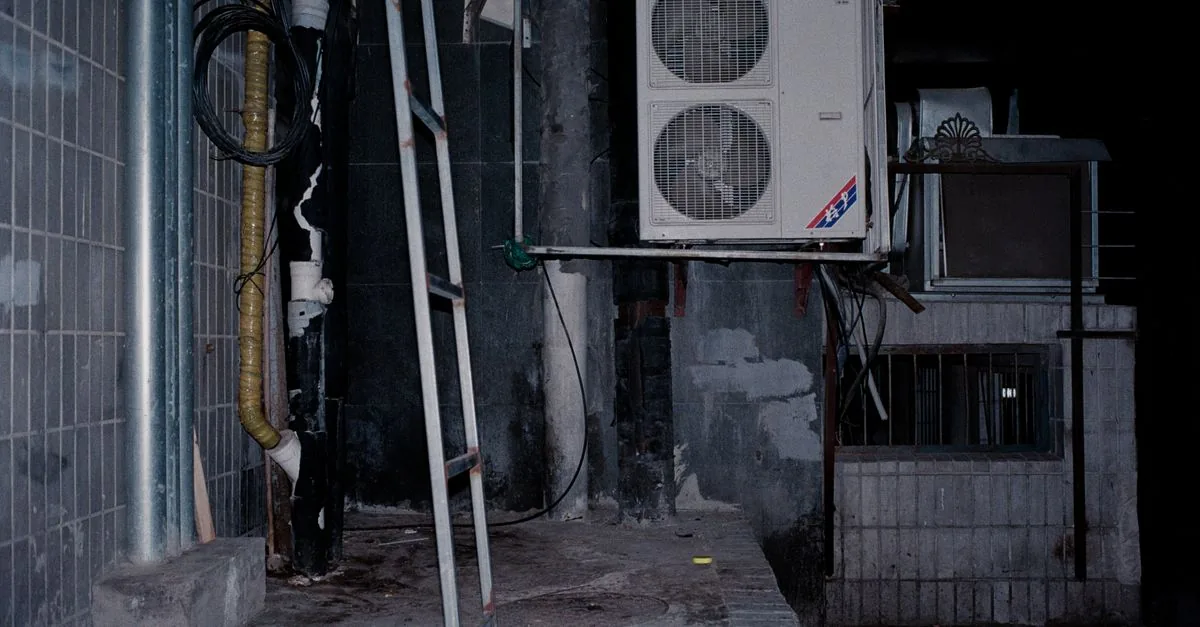
Here is what has happened. Your AC has two halves. The indoor unit blows air over a coil; the outdoor unit does the actual cooling work, with a compressor that circulates refrigerant and a fan that throws the heat away. If the outdoor half is not running, the indoor half is just an expensive fan — it blows room-temperature air and the room never cools.
That is why this symptom is so confusing. The AC looks alive. The display lights up, the remote works, air comes out. Everything you can see from inside the flat is fine, and the only clue is that the air is not cold.
Before anything else: this is not a refrigerant problem. Gas level does not stop an outdoor unit from starting. If the first thing you are offered is a refill, you are being sold the wrong job. Work down this page instead.
A note first. XpertWorker is a marketplace, not a service company. We do not set any professional’s price and we never charge you a paisa. Every professional quotes you free before starting, and you pay them directly.
In this guide
Check these before you call anyone
All free, all done from a safe distance, and the first two alone account for a lot of these calls.
- 1. Wait five minutes. Almost every split AC has a built-in restart delay of roughly three minutes before the compressor is allowed to start again, so pressures can equalise. After a power cut, or if you switched the AC off and straight back on, the outdoor unit will sit dead silent for that whole time while the indoor unit blows. In a Delhi summer of short cuts and restorations this happens several times a day, and it is the reason a perfectly healthy AC gets reported as dead. Set a low temperature, walk away, and come back in five minutes.
- 2. Check for a separate breaker or isolator. In many Delhi flats the outdoor unit is fed through its own MCB in the distribution board, or through a small isolator switch mounted on the balcony wall near the unit itself. A summer voltage swing can trip it on its own. Look for a breaker that is down, and look for that little switch box outside. One reset is fair — if it trips again, stop and read our guide on an AC that trips the MCB.
- 3. Confirm the mode and setpoint. In Fan mode the outdoor unit is supposed to stay off. So is it if the setpoint is above the room temperature. Set Cool at a low temperature and check the display actually changed.
- 4. Stand near the outdoor unit and listen. Silence, a steady hum with nothing turning, or a click followed by a grunt and then silence are three different faults. This is the most useful observation on the page.
- 5. Look at the fan through the grille. Not turning at all, turning very slowly, or turning normally while the compressor stays silent — note which.
- 6. Look for an obvious blockage. A bird’s nest, a plastic sheet, a dupatta, a bundle of cables or an accumulation of leaves jammed in the fan will stop it. Look, do not reach in, and switch the AC off at the breaker before anyone removes anything.
- 7. Record any blink pattern or error code on the indoor display before you power cycle. See our page on a blinking AC light.
Want a real quote for your own job?
Get free quotesIs the outdoor unit getting power at all?
If it is completely, absolutely silent — no hum, no click, nothing when the AC calls for cooling — the first question is whether power is reaching it.
- A tripped dedicated breaker or isolator. Covered above, and worth checking twice because the isolator is often in an awkward spot on a balcony or in a shaft and gets forgotten entirely.
- A stabiliser that has cut out. If the AC runs through a stabiliser, it may have shut down on low or high voltage and simply not restored. Look at its display or indicator lights. A stabiliser clicking repeatedly, buzzing or running hot is at the end of its life and causes exactly this. Our voltage and stabiliser tips cover it.
- Voltage protection holding it off. Modern boards refuse to start the compressor when the supply is outside a safe range. If the outdoor unit is silent only between roughly two and six on hot afternoons and starts fine at night, that is the supply, not the machine.
- A damaged interconnecting cable. The cable between indoor and outdoor units carries both power and the signal that tells the outdoor unit to start. Rodent damage, water ingress at a poorly sealed wall entry or a corroded terminal in the outdoor terminal block will stop it dead. This is common on units that have been outside through several Delhi monsoons. It is an electrician or technician job — do not open the terminal cover yourself.
If the whole AC is dead rather than just the outdoor unit — no display, no response to the remote — you are on the wrong page. Read our guide on an AC that will not turn on.
The capacitor: the commonest real fault, and the cheapest
If you take one thing from this page, take this. When an outdoor unit will not start, the capacitor is the most likely genuine fault, and it is a small inexpensive part. Ask about it by name before anybody says the word compressor.
A capacitor stores a charge and releases it to give the compressor and the outdoor fan the kick they need to start turning. Motors of this kind cannot start themselves without it. When a capacitor weakens with age — and heat is what kills them, so they fail readily in Delhi — the motor tries, cannot get moving, draws heavy current, and drops out on thermal protection a few seconds later.
What it looks like:
- A hum or buzz from the outdoor unit with nothing turning, lasting a few seconds and then stopping.
- The fan sitting still while you can hear the compressor trying, or the compressor silent while the fan runs.
- The fan starting if it is nudged, which is a classic weak-capacitor sign — but do not try this yourself, tell the technician you noticed it only if the fan visibly twitches on its own.
- The unit starting normally in the cool of the morning and refusing in the afternoon heat.
- A repeating cycle: tries, grunts, gives up, tries again a few minutes later.
Is it DIY? No. A capacitor holds a dangerous charge even after the power has been switched off, and it sits inside the outdoor unit’s electrical compartment next to live terminals. It is a quick job for a technician with the right part and the knowledge to discharge it safely, and it is nothing like a compressor in scale. That gap is exactly why it is worth naming.
The contactor, the fan motor, and the compressor itself
If the capacitor checks out, these are the next candidates, in order of how often they are the answer.
- The contactor. This is the heavy-duty switch that connects mains power to the compressor when the indoor board calls for cooling. Its contacts arc every time they close, and over years they pit, burn and eventually stop conducting. A failed contactor means the outdoor unit gets no power at all, so it stays completely silent while the indoor unit runs normally. Sometimes you hear a faint click as it tries to pull in and nothing follows. It is another small replaceable part, and a technician checks it in minutes.
- A seized or failed fan motor. The outdoor fan runs in the open air in one of the dustiest cities in the world, and its bearings take the punishment. A motor that has seized will hum and not turn, or grind and stop. On a unit sitting in a balcony full of construction dust this is a genuinely common failure. Sometimes the fault is only the fan while the compressor is fine — but never run the AC that way, because the compressor overheats fast without the fan cooling the coil.
- The compressor itself — last, not first. A genuinely failed compressor almost always has a history. It was getting noisy, or tripping the breaker, or cutting out after twenty minutes, for weeks before it stopped. A compressor that supposedly died overnight on a machine that was perfect yesterday deserves a second opinion, every time. Our guide on compressor replacement sets out what actually drives that decision.
- On an inverter AC, the outdoor control board. Inverter units drive the compressor through electronics rather than a simple contactor, so a failed board leaves the compressor silent. There is usually an error code with it. See inverter AC PCB repair.
- Overheating from a boxed-in installation. If the unit starts and then cuts out repeatedly rather than never starting, the outdoor unit may simply be unable to shed heat — crammed into a covered balcony, a light shaft or a grille cage with no free air. Our guide on outdoor unit placement covers the clearances a unit needs, and an AC that turns off by itself covers that pattern.
When to call, what to say, and what not to accept
Call once you have waited out the restart delay, checked for a separate breaker or isolator, and confirmed the mode. What you say next decides whether the technician arrives with the right part.
- Say the classic sentence. “The indoor unit blows normally but the outdoor unit does not start at all.” That one line already rules out half the possibilities.
- Say exactly what you hear. Complete silence, a hum with nothing turning, a click then nothing, or a grunt that gives up after a few seconds. This is the difference between a contactor and a capacitor.
- Say what the fan is doing and what the compressor is doing, separately.
- Say whether a breaker or isolator had tripped and whether it stayed on.
- Say whether it is time-dependent — fine at night, dead in the afternoon points at supply voltage.
- Read out any error code or blink pattern.
- Ask them to bring a capacitor for your unit if the symptom is a hum without turning. It is the likeliest fix and it saves a second visit.
Then the things to hold firm on. Do not accept a gas refill — refrigerant level cannot stop an outdoor unit from starting, and a refill offered for this symptom is a straight misdiagnosis. See our guide on gas refill charges for why that job exists at all. Ask whether the capacitor and the contactor were tested before anyone proposes a compressor, and expect a clear answer. Ask what was measured — supply voltage and current draw are real numbers. Ask for the old part back whenever anything is replaced. And get a second opinion on any compressor or board verdict, because those are the two quotes where the gap between opinions is widest.
If the outdoor unit does start but the room still will not cool, read our guide on an AC that is not cooling or on an AC blowing hot air. If it starts but sounds terrible, see an AC making noise. And once it is running again, a proper seasonal service keeps the dust off the fan and the coil — see our AC service guide and summer AC care tips.
Need an AC & Appliance Repair professional?
Get free quotes from independent, local professionals near you. XpertWorker never charges you — you pay the professional directly.
Get free quotes →Frequently asked questions
Why is my AC outdoor unit not running?
My AC indoor unit is working but the outdoor unit is not. What is wrong?
Why is my AC outdoor fan not spinning?
Is the capacitor or the compressor the problem when my AC will not start outside?
Why does my AC outdoor unit take a few minutes to start?
Does my AC need gas if the outdoor unit is not starting?
How we put this guide together
This guide is compiled from common Delhi NCR service patterns and reviewed by the XpertWorker team. XpertWorker connects you with independent, local professionals — we never charge you a paisa, and each professional sets their own price and quotes you free.